
New Research: Underwater Noise from Floating Wind Turbines and Harbour Porpoises
Peer-reviewed research from Xi and the Scottish Association for Marine Science provides measured, standards-relevant evidence on floating offshore wind noise, evidence that supports robust environmental impact assessment and consenting.
Floating offshore wind (FOW) is expanding into new areas of deep water, and with it comes a familiar challenge for anyone responsible for consenting, compliance, or technical due diligence: the evidence base for underwater noise impact is still being filled in.
Our Principal Engineering Consultant, Dr Brett Marmo, has co-authored newly published research addressing this directly, working alongside the Scottish Association for Marine Science (SAMS) and colleagues from the University of Aberdeen. The chapter, “Underwater Noise Produced by Two Types of Operational Floating Wind Turbines and Preliminary Data on Harbor Porpoise Responses,” appears in The Effects of Noise on Aquatic Life IV (Springer, Open Access); independently reviewed, and grounded in real measured data rather than modelled assumption.
Understanding the Underwater Noise Impact of Floating Offshore Wind
Fixed-bottom offshore wind noise is relatively well understood, but floating platforms introduce new variables: different foundation geometries, mooring systems, and deployment depths, all of which can change how noise is generated and transmitted underwater. As FOW arrays scale up and move into deeper water, understanding this noise, and how it might affect noise-sensitive species like harbour porpoises, is becoming an increasingly important part of environmental planning and consenting.
Xi Co-authors New Research with the Scottish Association for Marine Science
The study was led by SAMS, with Xi contributing engineering, acoustic data processing and underwater noise propagation modelling to characterise the noise sources at two real-world FOW sites.
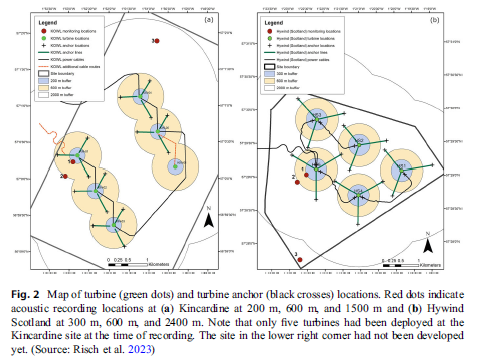
Two demonstration sites: Hywind Scotland and Kincardine
The research team acoustically monitored Scotland’s two operational demonstration FOW arrays. Hywind Scotland uses spar-buoy foundations, while Kincardine uses semi-submersible platforms, giving the study a useful comparison between foundation types.
Acoustic monitoring equipment was deployed at multiple distances from the turbines at each site, alongside passive acoustic detectors used to identify harbour porpoise echolocation clicks.
What the study found: drivetrain noise and mooring-related transients
Two distinct types of underwater noise were identified across both sites.
1. Drivetrain-related noise increases with wind speed
Continuous noise linked to the turbine drivetrain was concentrated mostly below 120 Hz at both sites, with distinct tonal features, and increased with wind speed. Source levels were generally higher at Kincardine, where the larger, higher-rated turbines use geared drivetrains, unlike the direct-drive turbines at Hywind Scotland.
2. Mooring system transients differ between foundation types
Separately, the study identified short, intermittent broadband transients, described as “snaps” or “bangs”, linked to the mooring systems holding each platform in place. These occurred considerably more often at Kincardine than at Hywind Scotland, particularly during periods of higher wind speed and wave height. This mooring-related noise is a distinctive feature of floating wind that doesn’t have a direct equivalent in fixed-bottom turbine noise profiles, and the study notes further work is needed to establish its exact source.
Why this matters for environmental impact assessment and consenting
As FOW deployment expands into deeper water and larger array sizes, cumulative underwater noise is an increasingly important consideration for Marine Spatial Planning and Environmental Impact Assessment.
This research provides real, empirically measured data from two operational sites, exactly the kind of evidence that underpins robust, defensible EIA work and supports smoother consenting processes for future projects.
Early data on harbour porpoise presence near floating turbines
Harbour porpoises were detected regularly at both wind farm sites throughout the monitoring periods.

Detections were consistently higher at recording locations further from the turbines than at those closest to them, at both Hywind Scotland and Kincardine. While the researchers note this is preliminary and more data is needed to confirm the pattern over time, it’s an early signal worth watching as the evidence base for FOW’s marine mammal impacts continues to grow.
What our engineers and research partners are saying
“Floating offshore wind has an important role to play in our future energy mix, but it must be developed responsibly, with proper consideration for marine life and other users of the marine environment. This project allowed us to apply acoustic data processing and modelling to noise measurements from operational wind farms. Mooring-related noise has received less attention than drivetrain noise, and our findings show that it shouldn’t be overlooked.”
Dr Brett Marmo, Principal Engineering Consultant, Xi Engineering Consultants
“Collaborating with Xi brought valuable engineering and acoustic measurement expertise to this project, helping us characterise and model the impact of these noise sources with real operational data from two very different FOW platforms.”
Dr Denise Risch, Senior Lecturer and Acoustician in Ambient Underwater Sound, Scottish Association for Marine Science (SAMS)
Ready to talk about noise and vibration on your offshore wind project?
If you’re working on a floating offshore wind project and want to discuss noise and vibration monitoring, environmental impact assessment, or what this research means for your consenting process, our team would be glad to help.
The full published chapter is available via Springer. If you’d like a copy to read in full, get in touch and we’ll send it over.
Read more about what we provide
Underwater acoustic modelling to support tidal array EIA