
Validating solar shading design against wind, vibration and noise
Levolux asked Xi Engineering Consultants to evaluate the aerodynamic, structural and acoustic behaviour of a new solar shading louvre system, using CFD, modal analysis and acoustic assessment to de risk performance and avoid costly redesign.
The Challenge
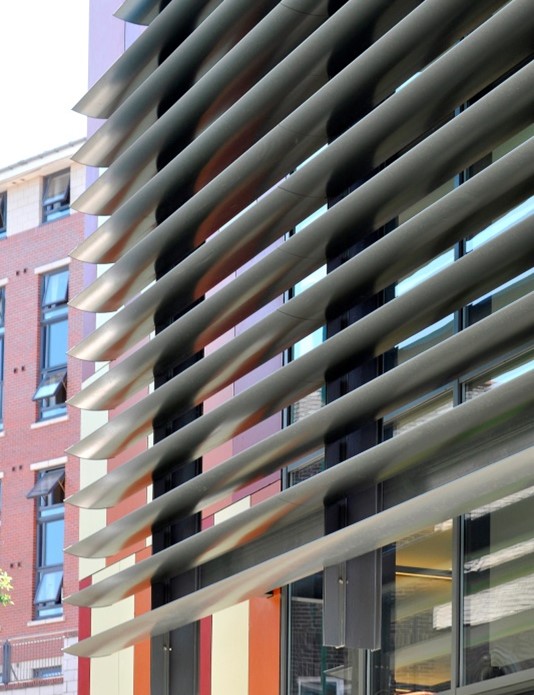
Levolux, a leading supplier of solar shading and screening systems, was developing a new louvre array for use on urban buildings. The system needed to manage solar gain while withstanding site wind conditions, avoiding structural vibration and controlling noise for neighbours and building users. Any post installation issues would be expensive and disruptive to rectify. The team wanted confidence that the design would perform as intended across realistic operating conditions and would satisfy relevant noise and comfort requirements before committing to manufacture.
Our Approach
Xi built a staged analysis workflow to examine the louvre system from multiple angles. First, CFD simulations were carried out to calculate drag, pressure distribution and pressure drop across the louvres at different angles and wind speeds. This data was then coupled to modal analysis to identify natural frequencies and mode shapes, ensuring that key wind loading frequencies would not excite damaging resonances.
A further CFD based study examined vortex shedding and its interaction with the structural response. Finally, Xi assessed likely sound pressure levels resulting from wind interaction with the louvres, checking these against typical urban noise expectations. Throughout, the analysis was set up to be re used as part of a future digital twin if the client wished to monitor performance in operation.
The Results
Why it matters
Architectural features exposed to wind can create complex combinations of loading, vibration and noise that are hard to predict without advanced modelling. This case demonstrates how Xi’s CFD, structural dynamics and acoustic capabilities can be combined to give manufacturers and developers early confidence in new façade systems. The same method can be applied to brise soleil, cladding, canopies and other exposed structures, supporting planning approvals and protecting long term performance.