
Optimising piezoelectric transducers for data transmission in harsh environments
Xi Engineering Consultants designed and optimised a piezoelectric transducer for structure borne data transmission, modelling performance across operating conditions to deliver robust communication where electromagnetic methods struggled.
The Challenge
A client transmitting data from an extreme environment had previously relied on electromagnetic communication, but interference and attenuation in the local conditions led to unreliable links and data loss. They turned to structure borne sound as an alternative, aiming to send information through solid material using piezoelectric transducers. The challenge was to design a transducer that converted electrical signals into mechanical vibration efficiently and operated at frequencies that would remain effective despite changes in structural resonances and loading. Achieving this with minimal prototyping required a simulation led design approach.
Our Approach
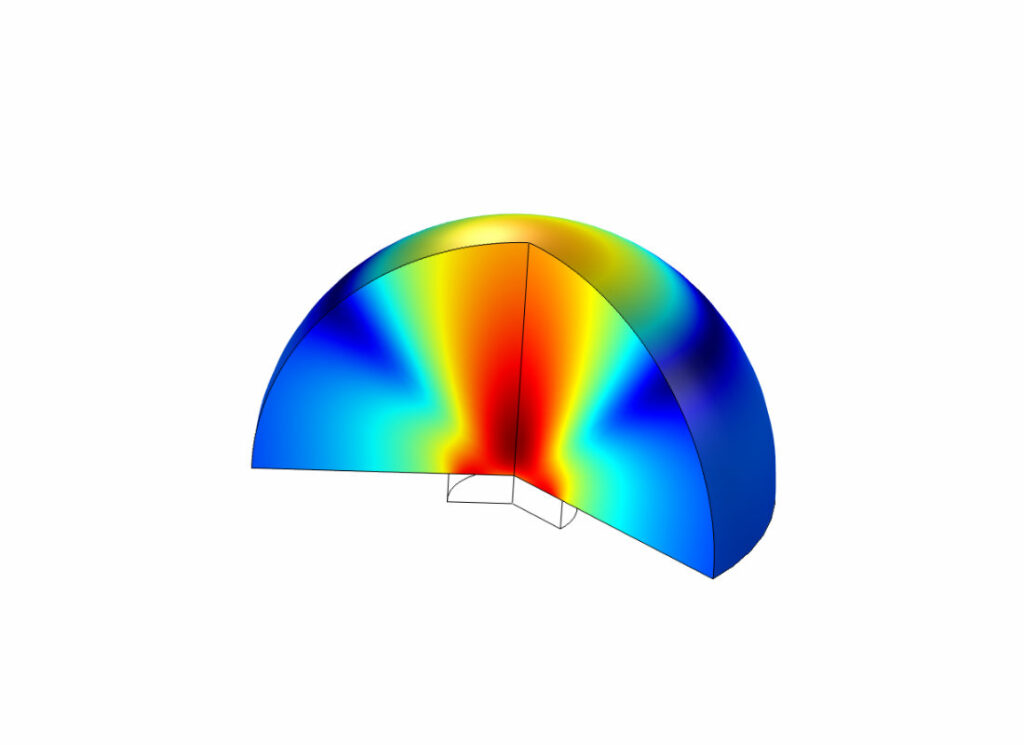
Xi modelled several piezoceramic transducer geometries, capturing the coupling between electrical drive, structural response and acoustic propagation into the host structure. Frequency domain analysis was used to identify resonances and understand how they shifted as the effective mass and boundary conditions changed. By studying these variations, Xi identified frequency bands where vibration amplitude remained relatively stable across operating scenarios, providing a robust window for data transmission. The final concept used multiple piezoelectric elements working together to excite these favourable frequencies, with geometry and layout tuned in simulation to maximise conversion efficiency from electrical input to structural vibration.
The Results
Why it matters
In many harsh or electromagnetically noisy environments, structure borne sound offers a compelling alternative for data transfer. However, designing robust piezoelectric transducers is not trivial, especially when structural resonances shift with loading and temperature. By combining detailed modelling of piezoelectric behaviour with practical application constraints, Xi helps clients develop devices that work reliably where traditional communication methods fall short.